


Table of Contents
The extortion group ShinyHunters recently breached Instructure, the company behind the widely used Canvas learning management system. This attack hit educational institutions across the world and serves as a massive wake-up call for K-12 supply chain security.
The attackers claim to have stolen 3.65 terabytes of data affecting 275 million students, teachers, and staff across nearly 9,000 schools. In a second wave of attack, several days after the initial outage, ShinyHunters accessed the portal and sent targeted ransom messages directly to schools. Canvas was again forced to take down the platform. This multi-layer attack seems to have been planned for maximum effect, hitting schools and major universities around the world at the busiest exam period.
This event proves that K-12 school districts are highly vulnerable to the security shortcomings of their trusted vendors. We are going to look at the details behind this breach, and what you can do to ensure your educational institution remains safe from the fallout.
Quick Facts: ShinyHunters Breach of Instructure
|
How Did ShinyHunters Breach Instructure?
ShinyHunters have been active since 2020. They have previously taken responsibility for attacks against a variety of organizations, including Santander Bank, AT&T Wireless, Google, Qantas, Jaguar Land Rover, the European Commission, and Rockstar Games. They are known for using a pay or leak strategy, where victims who don’t pay a ransom will have their stolen information leaked on the dark web.
Attackers exploited a system vulnerability to compromise Application Programming Interfaces (APIs) and privileged credentials. To contain the incident, Instructure revoked privileged credentials and access tokens. The EdTech company also deployed security patches to close the exploited vulnerability and forced a rapid rotation of application keys. Customers were required to manually reauthorize access to the Instructure API to receive new keys and restore integrations.
Despite these containment efforts, the extortion group ShinyHunters claimed responsibility on a Tor-based data leak site on May 3. The threat actors allege they extracted 3.65 terabytes of data, containing up to 275 million user records.
This data allegedly includes personally identifiable information, email addresses, student identification numbers, and billions of private Canvas messages. The sheer volume of exposed data underscores the severe blast radius of compromised API infrastructure in cloud-hosted educational tools.
What Does the Instructure Breach Mean for Traditional School Defenses?
The Instructure breach exposes how traditional school defenses can be completely bypassed when threat actors compromise a trusted third-party vendor. School districts invest heavily in firewalls and endpoint protection to secure their perimeters but these traditional tools offer zero protection when an adversary targets the cloud infrastructure of an educational partner.
ShinyHunters did not need to breach thousands of individual school firewalls. They exploited a single centralized platform to access student data across the globe.
The implicit trust placed in educational technology providers can create a blind spot for school data environments. When an attacker has access to legitimate credentials, their data extraction looks like legitimate traffic to traditional security tools.
The Instructure incident proves that relying solely on preventative perimeter defenses leaves schools dangerously exposed to supply chain attacks. IT leaders must accept that their defensive perimeter now extends far beyond their direct control.
Why Must Schools Shift to an Assume Breach Mindset?
An assume breach mindset builds cyber resilience by shifting your security focus from impossible prevention to rapid detection. You cannot control what happens to your vendors, but you can control your response. K-12 networks rely on dozens of third-party platforms to operate smoothly, and this deep integration makes a future compromise highly probable. IT leaders must operate under the assumption that attackers will eventually breach a trusted educational partner.
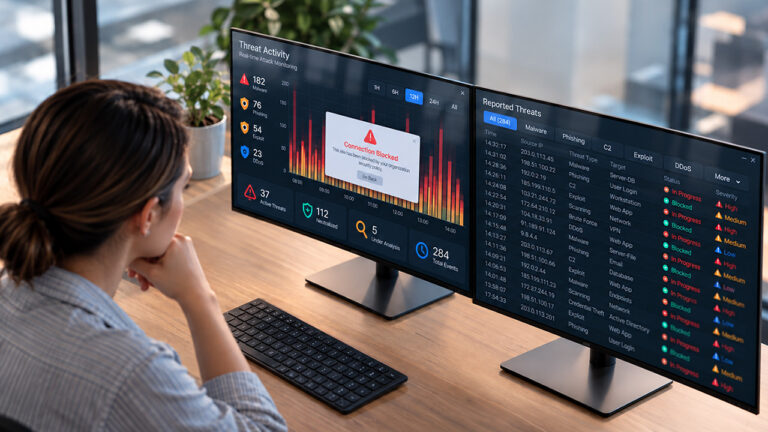
Achieving this level of resilience requires total visibility into how data flows across your environment. Because school networks are highly dynamic, defenders must be able to distinguish between legitimate educational activity and anomalous behavior. By establishing a baseline of normal network traffic, IT teams can immediately flag deviations from the norm like a sudden surge in login attempts from an unusual geographic location or large-scale data transfers to an unauthorized external server. Identifying these subtle patterns in real-time is the only way to stop a vendor-related breach from becoming a full-scale data exfiltration event.
It is also essential to limit the attack surface. Use a tool, like Lumu Discover, to find out what adversaries know about your network and uncover any unprotected devices. Discover also allows you to assess third-party risk. This gives you visibility into your external attack surface and keeps you up to date if your supply chain is breached.
Discover how Lumu empowers K-12 teams to detect network threats in real time.


Share this post